
Setting Standards (part 1)
The jazz tradition in the early 1980s: Wynton Marsalis plays standards.

This post, part 1, discusses Wynton Marsalis. I am finishing up the second part, on Keith Jarrett and Chick Corea, and will post it in the next couple of days.
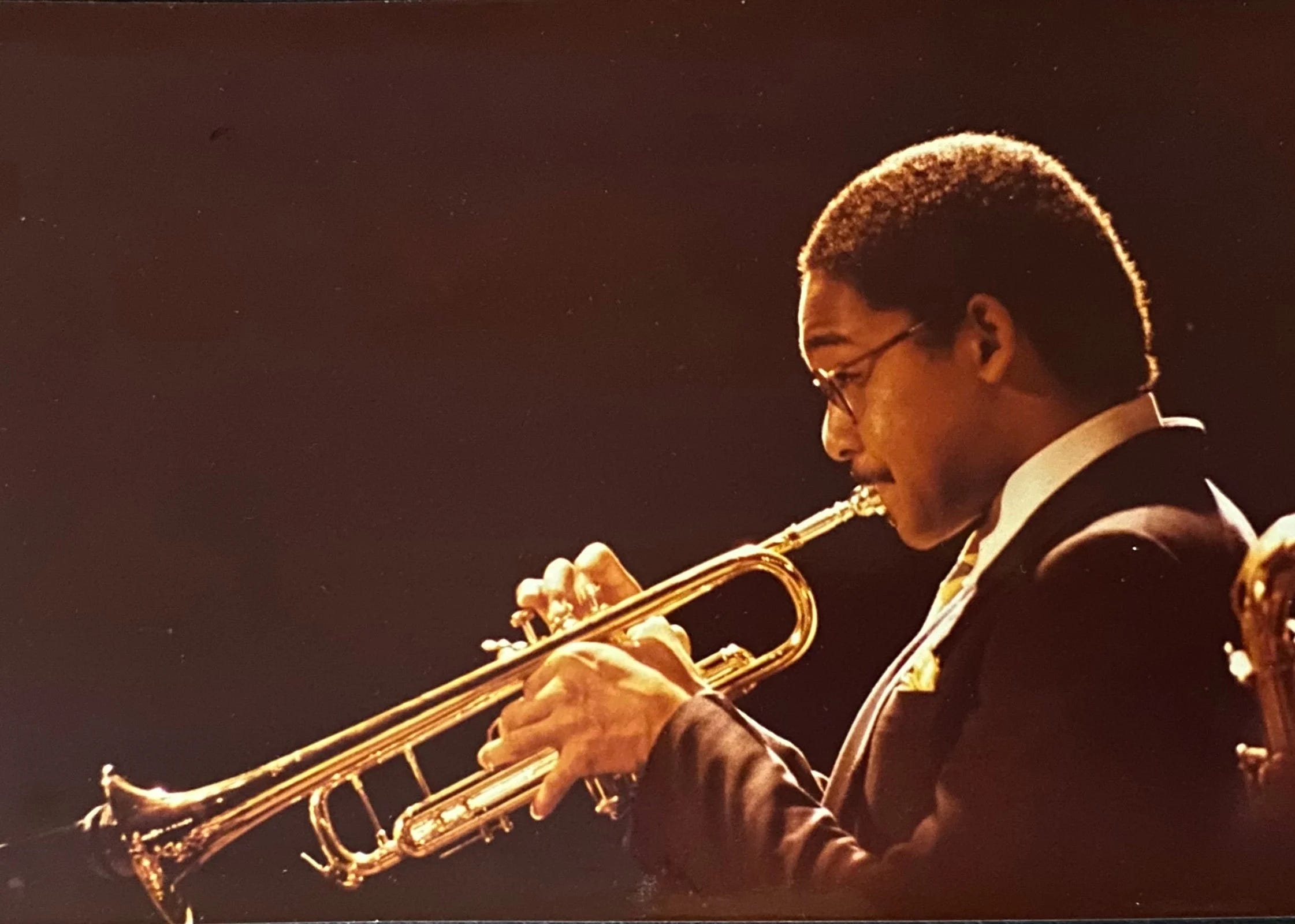
In 1982, Wynton Marsalis recorded his debut album featuring, alongside his peer musicians, the jaw-dropping rhythm section of pianist Herbie Hancock, bassist Ron Carter, and drummer Tony Williams. Marsalis may have been signalling his allegiance to post-bop from the start, with himself as Miles and his brother Branford as Wayne Shorter, but it soon became clear that this allegiance was firmly bounded; despite Hancock and Williams’s deep roots in jazz fusion and the avant-garde, Marsalis was interested in their status as ‘elders’ who still symbolised the last great ‘golden age’ of jazz in the mid-1960s, before Miles, Chick Corea, and Wayne Shorter ‘sold out’ to create, as Marsalis saw it, dumbed-down pop and funk music.
What can be overlooked, however, is that Marsalis’s debut and quick rise — often seen in hindsight as the start of a new movement by young musicians to return jazz to more swinging, bluesy, post- and hard-bop roots — was far from the only thesis statement of jazz being recorded in the early 1980s.1 In November, 1981, Chick Corea reunited his 1968 Now He Sings, Now He Sobs trio with Miroslav Vitous and Roy Haynes to make the standards record Trio Music, followed in 1984 by Trio Music Live in Europe; in January, 1983, Keith Jarrett recorded two albums’ worth of standards (as well as a third album of original music) with bassist Gary Peacock and Jack DeJohnette, which were released in 1983 and 1985 as Standards Volume 1 and Volume 2.
I am not interested in the Corea and Jarrett trios as rebuttals or negations of Marsalis’s perspective. In making his early statements (musical and otherwise), Marsalis was — in his view — reclaiming jazz from the white-dominated record executives, producers, and musicians who had pushed Black music away from swing and the blues and towards rock, pop, funk, and fusion. By highlighting Buddy Bolden, Louis Armstrong, Duke Ellington, Clifford Brown, and the pre-fusion music of Miles Davis, Marsalis was championing masters who had, in his eyes, been overshadowed by the likes of Chick Corea and Keith Jarrett, and even the Black musicians like Herbie Hancock and Wayne Shorter who had ‘abandoned’ jazz, in ways that smacked of Paul Whiteman or minstrelsy. In this, Marsalis was acting anything but cynically, and he was motivated, as far as I can see, by a deep love of the music.2.
Yet Wynton’s work with Tony Williams, Ron Carter, Herbie Hancock, and even Elvin Jones is, to my ears, using jazz elders in service of an ideological argument, not a purely musical one. Marsalis’s debut record and subsequent music and interviews set off a long controversy over innovation versus tradition in jazz. The Ken Burns documentary from 2001 is now seen not as an authoritative document but as Marsalis-guided ideological revisionism. As Marsalis’s relevance on the jazz scene faded, the importance of boundary-shifting young musicians like Chris Potter, Brad Mehldau, Kurt Rosenwinkel, and the Bad Plus grew. Ethan Iverson and others (including, at the time, the late critic Francis Davis) have written eloquently about one misfortune of the Marsalis ascendancy, namely that the vibrant and deeply creative avant-garde scene of the 1970s and 1980s was criminally under-heard and under-recorded. But, in my opinion, there is another unfortunate consequence. The hard-line Marsalis argument inevitably created a backlash, not only against Marsalis but more broadly against ‘tradition.’ Young musicians didn’t want to be boring old fogeys, so they increasingly avoided standards-heavy setlists in favour of original compositions, and straightahead swing in favour of funk, rock, and hip hop-influenced grooves. Iverson recently phrased this better than I ever could: ‘Wynton Marsalis and cohort gave many a pass to ignore the tradition.’
I think that the Marsalis-driven debate over tradition obscured the real substance of the music being played, both by Marsalis himself and others, and that Marsalis’s prominence as a figurehead of ‘tradition’ in jazz can distract from other inquiries into the way tradition was being carried forward in the jazz of the early to mid-1980s. A critical difference, in my opinion, between Wynton on the one hand and Jarrett/Corea on the other — a difference crystallised for me by reading Ethan Iverson, Francis Davis, and Lewis Porter — is that while Wynton positioned himself from the start as an authority, a ‘young statesman’ who could pull jazz back to important traditional values, Jarrett and Corea, far deeper into their careers than Wynton was in the early 1980s, continued to learn ‘from the source,’ as it were.
In pieces on Wynton and Branford first published from 1983-1984 and collected in the invaluable In the Moment: Jazz in the 1980s, the late critic Francis Davis writes:
[Wynton] Marsalis is as infuriating a paradox as Tom Wolff’s astronauts — a rugged individualist out to restore traditional values with little tolerance for those who play by a looser set of rules; a straight-arrow who talks like a rebel, though what he’s rebelling against is non-conformity. […] Marsalis… overdramatizes the plight of jazz before his coming, but let it pass — it is indisputable that he has had a rejuvenating effect on jazz, if only in terms of winning it more media coverage. [… But t]he critical backlash that has been mounting against the Marsalis brothers is, I think, more an expression of dismay at their musical atavism…. After all, jazz has undergone countless stylistic permutations since those mid-60s Miles Davis LPs that serve as Wynton and Branford’s point of departure were first issued. The brothers’ belated discovery of those records3 may have tricked them into thinking they were hearing something new…. They have accomplished so much so fast that it is sometimes shocking to realize how much they still have to learn — I once heard Branford play Johnny Mercer’s ‘I’m An Old Cowhand,’ which he announced afterwards as ‘a tune by Sonny Rollins, called ‘Way Out West.’4
Dr Lewis Porter agrees, and goes further when discussing Wynton’s role in the divisive Jazz documentary by Ken Burns:
[T]he problem with his [Burns’s] primary consultant, Wynton Marsalis, is that he was unable or unwilling, it seems, to say that there were some subjects that he was not qualified to discuss…. Now, as I understand it, Marsalis’s “shortcut” method when asked to discuss something he didn’t know much about, at least at that time, was to obtain a relevant album, do some quick listening, and form an opinion.
[…]
The Ken Burns segment on Keppard features Marsalis demonstrating the “laughing cornet” routine of Elwood Graham, followed by Punch Miller (or someone else) on a recording. It contains Nothing — and I mean Zero — by Keppard! How embarrassing that would be, if Burns and Marsalis even knew their error — but they don’t.
Should a documentarian be proud that he or she knew nothing about the subject? I say, in the strongest possible terms, no, no and no! This is also a good example of why my method is to hear, as much as possible, Everything by a given artist before presuming to discuss that person’s style. That takes time — and there is no shortcut.
In essence, Marsalis too quickly moved from a period of apprenticeship to a place of authority — often not even musical authority, but moral or spiritual authority. Rather than seeming like a continuation of his work as a ‘student’ in Art Blakey’s Jazz Messengers, Marsalis’s recordings with Hancock, Carter, and Williams read, to my ears, as a statement of dominance: that Marsalis can hire these legends to save them from themselves, to reclaim traditional jazz values in the face of these elders’ own missteps. As Sara Murphy, the wife of artist and businessman Gerald Murphy, once wrote to F. Scott Fitzgerald, ‘If you don’t know what people are like, it’s your loss…. But you ought to know at your age that you can’t have Theories about friends. If you can’t take friends largely, & without suspicion — then they are not friends at all. […] You don’t even know what Zelda or Scottie are like — in spite of your love for them. It seemed to us the other night… that all you thought and felt about them was in terms of yourself’ [emphasis original]5. Marsalis was not accepting of the totality of Hancock and Williams as musicians: he was playing with them, but only part of them, the part that served his own ideological purposes.
Davis, writing at the start of Marsalis’s career, is generous to Marsalis; Porter, all these years later, is less so. But both are highlighting the same issue: a lack of depth of experience in Marsalis’s presentation of tradition, a kind of playing dress-up musically as well as sartorially. Pastiche can be the trap of tradition. I am finishing up a long piece on Blue, the 2014 re-recording of Kind of Blue by Moppa Elliott’s band Mostly Other People Do the Killing, and my primary antagonist, critic Richard Williams, indicts Blue for (in his view) simply aping the creativity of others. Even as a student playing in my college’s jazz ensemble, I was scolded by faculty for suggesting tunes like Monk’s ‘Bye-Ya’ without ‘having something new to say with it,’ by which they meant a creative arrangement or reimagining. However, a worship of the ‘new’ can easily become a worship of innovation in packaging alone, as Ethan Iverson discusses here. For Iverson, the innovation lies in the personal substance of the musician’s statement, not in the more superficial trappings of arrangement or instrumentation:
A lot of the versions of “Cherokee” and other standard repertoire on YouTube from this cohort are “good” but that’s all. In my opinion, you can’t really play “Cherokee” until you are playing your own stuff on “Cherokee.” (That’s why I dig Wynton’s encores of “Cherokee” so much, his language is totally personal.)
[…]
It is worth recalling that the “Young Lion” movement in the 1980s was a sound and an idiom. It was personal. The drummers were key: Jeff “Tain” Watts, Ralph Peterson, Marvin “Smitty” Smith. Almost as important were the piano players: Kenny Kirkland, Mulgrew Miller, Donald Brown, Geri Allen. Just a magnificent roar of black jazz. There were allusions, of course, there always are, but it was still a sound.
By the ‘90s things had smoothed out a bit, especially from Wynton, who went from having Tain to Herlin Riley in his band.
I agree, but I see the roots of Wynton’s drift from the personal earlier in his career, and as specifically polemical.6 There’s a version of ‘I’ll Remember April’ on the Marsalis Village Vanguard box that is played in the classic Clifford Brown/Max Roach arrangement, though Marsalis doesn’t indicate this in his introduction. As a young jazz listener, I loved this arrangement, which seemed playful and creative, but as I listened to more music and finally heard the original Brown/Roach recording, I was disappointed in Marsalis — the playfulness and creativity I’d heard in his version was not actually his, but was Brown and Roach’s. Marsalis is playing personally here — the quickest of listens to his style reveals how deeply he loves Clifford Brown — but he is also playing a pastiche. Because Marsalis discarded a level of humility in his own musical development and picked and chose which elements of jazz masters he would accept or reject, the ‘I’ll Remember April’ arrangement seems less like earnest apprenticeship and more like a lecture: this is right, and other ways are wrong.
Wynton’s ‘April’:
Max Roach’s ‘April’:
To return to Iverson: is this a ‘personal’ performance by Marsalis? I struggle, now, to hear it as such. Inevitably, I hear the Roach/Brown recording, and know that Marsalis wants us to hear it, because that is real music, and he is the ambassador of it (‘a machismo drive toward furthering its propagation,’ as Davis phrased it).
As a contrast, listen to Thick In the South, the first volume of Marsalis’s 1991 trilogy Soul Gestures in Southern Blue (an underrated set of records). ‘L.C. On the Cut’ features, alongside Wynton’s working band, drummer Elvin Jones and tenor saxophonist Joe Henderson:
This is not lecture music! To my ears, there is something more immediate, more flowingly creative, and ultimately less self-regarding about this track than the septet’s ‘I’ll Remember April’ (great as it is). And yet, unlike the Village Vanguard sets, this record is explicitly ideological. In his somewhat overwrought liner notes, Stanley Crouch writes that the record is a ‘victorious statement of adventurousness and of the grasp of the soul essentials:
The arrangements balance and contrast the positions of each of the instruments for the expression of a thorough understanding of the call-and-response that leads us all the way back to chattel field hollers and the Negro spirituals that underlie blues crooning…. [Marsalis’s] inventions have the authority of deep blues feeling, something many of us had come to believe we would never hear from musicians born after 1960.
Marsalis, too, makes an ideological claim for the record:
I wanted to play some trumpet out of the line that comes from King Oliver and Louis Armstrong over to people like Sweets Edison and Ray Nance and Doc Cheatham. But I’m not talking about a particular style; I’m talking about an attitude toward the horn itself. Fats Navarro had that attitude; his ambitions were clarion. So were Clifford Brown’s and Booker Little’s and Freddie Hubbard’s. Miles Davis understood it in his jazz period, too.
Of one of my favourite tracks, Marsalis says,
“So This Is Jazz, Huh?” This question is asked by a couple upon arriving at a jazz concert out of curiosity. Perhaps they have heard some pop type of jazz on the radio and come full of expectation. The music starts. It is a blues in a major tonality, a mellow sound using a subtle groove somewhat reminiscent of what might be heard on late night radio. It continues. Alas, it is a blues using many different chords, the language, swing, modulations, and improvisations of actual jazz. They exchange glances that say, “Do we like this?” Then one of them says to the other or they say in unison, “So This Is Jazz, Huh?”
Marsalis was born in 1961: he was only thirty years old when Thick in the South was recorded, and already nearly ten years into a high-profile and lauded jazz career. Discussing Elvin Jones, Marsalis notes that ‘There is a deep, deep majesty to Elvin that comes from a very rare combination of great talent, discipline, and sincere humility. That humility is why he continues to develop.’ There isn’t much humility to Marsalis’s statements in the liner notes to the record, from his sanctimonious ‘in his jazz period’ scolding of Miles Davis to ‘some pop type of jazz on the radio’ to his condescension towards his imagined jazz neophytes (‘Alas, it is a blues using many different chords…’) who are ultimately enlightened by his music. Marsalis’s singling out humility in Elvin Jones is already audacious — Jones was humble, but if anyone had earned the right not to be, it was him! — and looks even more so next to Marsalis’s own arrogance. His statements in the liner notes are at odds with the performances on the record itself: when it came to his musical philosophy, Marsalis was already an expert — his learning had ended.7
In part 2: Marsalis was far from the only prominent jazz musician returning to the tradition in the early 1980s. I look at Keith Jarrett and Chick Corea’s standards trios of these years, and specifically the roles in them of drummers Jack DeJohnette and Roy Haynes. Thanks for reading!
I am about to focus on standards, but I want to note that there is an entire other essay I could write from this exact same launching point. There was another kind of ‘traditional’ jazz of the 1980s, spearheaded by musicians like David Murray and Arthur Blythe who played few standards but whose originals were deeply infused with the entirety of jazz history (and were perhaps less informed by Miles than by Mingus, who has never had a prominent place on Wynton’s jazz Pantheon).
While I struggle more with Marsalis’s role and legacy, the fact is that Marsalis’s work from this period (the early to mid-1980s) is personal, sincere, and deeply rooted in the blues and New Orleans traditions. I have a hard time with Marsalis’s perspective on jazz (espoused in the Ken Burns documentary, for example) as being, à la Lin-Manuel Miranda’s Hamilton, an expression of the hopefulness and vitality of core American ideals (freedom, democracy, the individual’s power to succeed based on merit and ‘the content of one’s character’), and an expression of these ideals as, in jazz, being as fundamentally accessible to Black Americans as white — it’s a bit too model-minority for me, a bit too Booker T. Washington.
Davis quotes Branford as saying he first heard Miles Smiles and the other mid-60s Miles records via Marvin ‘Smitty’ Smith as a sophomore at Berklee in 1979 — ‘three years later, Marsalis was touring Japan with Hancock, Carter, [and] Williams’.
Actually, Branford was still doing this as late as 2011: in an old NPR piece, he describes Frank Sinatra’s ‘One For My Baby’ at the Sands as being by Sinatra and Count Basie, ‘a classic standard interpreted by two of the great musicians’ — despite the fact that Sinatra famously used his own pianist, Bill Miller, for this song. It’s not inside baseball — Miller’s performance is actually described in detail in the original liner notes to the record.
As quoted in Living Well is the Best Revenge by Calvin Tompkins.
Ethan makes this ‘polemical’ or at least ‘political’ argument for this treatment of tradition as well: ‘Cohen is an excellent pianist—like an amazingly excellent pianist— but after listening to him for more than a decade, I have no idea how he plays, meaning I can’t recognize him in a blindfold test. He just goes from one borrowing to another with a big smile on his face. This is now common from a certain crew. Straight-ahead jazz, very well done, and about as idiosyncratic as going to the gym, checking your stocks, and talking to ChatGPT. […] Whatever all this is—I don’t really understand it and don’t want to understand it, either—it seems to be part of the Wynton Marsalis legacy, not just through JALC but also through the Juilliard School, where Wynton has led the jazz program since 2014. I am sure that (as within any student body) there are plenty of disagreements and experiments happening at Juilliard Jazz, but the overall impression is that of a specific party line’.
In a Davis article from 1984, Marsalis lists Don Cherry as an influence and then spends a whole paragraph dissing him: ‘Cherry has never bothered to learn his instrument…. Every musician who has been a jazz innovator has been a master technician — every single one. So you can’t include Cherry among the innovators.’
FWIW I don't dig that Wynton Vanguard set much, I never have, and in terms of standards, it's specifically the Wynton encores of "Cherokee" that sound remarkably personal to me. My Wynton pantheon is BLACK CODES, J MOOD, and encores/casual moments of "Cherokee." (Which is more entries into my pantheon than most get!)
This was an interesting piece. Some years ago I reviewed all six of the Marsalis Standard Time albums; some I liked a whole lot, others not much. https://burningambulance.com/2019/04/30/marsalis-standard-time/